
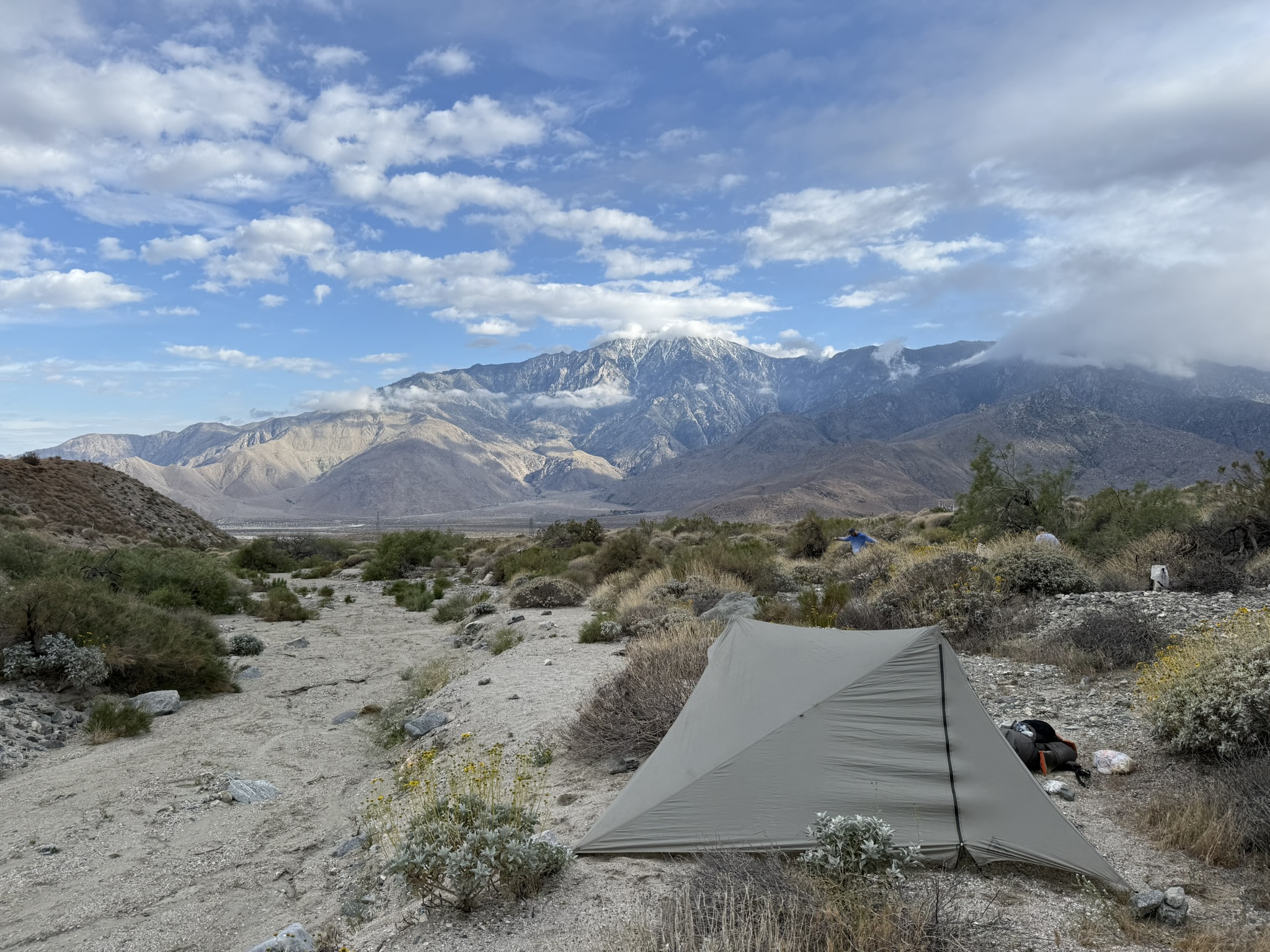
One of the most unique features of the PCT desert section is Mount San Jacinto. A gargantuan granite island rising from the relatively flat desert. Almost like an alpine oasis, filled with various pine species, birds, and larger animals such as mule deer, mountain lion, and big horn sheep.
Mount San Jacinto is also one of the first tastes of “real” mountains on the PCT. The terrain is much more dramatic than everything else seen before. Various blowdowns and snow drifts cover the trail on steep slopes, making it the most technical stretch of trail yet. Narrow trails on exposed ridgelines and poodle dog bush fight for your attention while trying to carefully place each step.
Despite an abundance of snow melt and greenery at higher elevations, the hike up to Mount San Jacinto is a long and dry one. There is not much more water to be found than there was in the desert below, and sometimes even less. Your options for water are one of the various springs on the mountain, all of which require you to descend hundreds of feet from the main trail you just fought so hard to climb, down to a spring that feels miles away, and sometimes actually is. All of that just to fill a bottle and turn back around. The reward for the time you spent and the extra miles hiked is the fresh mountain water. It truly tastes better than almost anything else. Mountain water has this clean, biting freshness that can’t quite be accurately described until you have experienced it for yourself.
As you reach the higher elevations of the mountain you feel yourself gradually entering an entirely different world. The air has a crisp dampness similar to a spring melt, the chickadees sing their “cheeseburger” melody, and the pines whisper in the wind. After weeks of sand and shrubbery you are enveloped by a dense, towering canopy. This is the first time on the PCT you feel like you have entered the mountains you had dreamed of when deciding to do the trail.
After entering this paradise the trail itself lets up. The grueling climbs, snow crossings, and blowdowns yield to a smooth and rolling path, the ground shifting from rock to needle-covered loam. Everything is suddenly just a little easier. It feels as if the mountain itself is congratulating you and is now gently pushing you forward.
The respite is short. Soon it is time to descend the backside, and the mountain reveals a different personality entirely. It wastes no time on the way down and reveals a much steeper trail than the way up. The canopy conceals the snow from the sun, leaving miles of slick, snow covered terrain ahead. The distance is shorter but it takes twice as long, each step carefully planted, each misplaced footstep a potential disaster. What was just congratulating you is now demanding your full attention again. Generous and unforgiving in equal measure.
Some miles later, 7,700 feet of descent behind you, and nerves still raw, you reach the bottom. Just like that and you are back, the desert stretching all around you. As you put distance between yourself and the mountain you turn back, and only then can you fully appreciate the scale of what you just walked over. From the north it appears as a near vertical wall, imposing and indifferent, rising straight out of the desert floor. It looks like a task impossible to conquer. And yet you did it. Your legs may be tired but your confidence has been reinforced, hardened into something unshakeable. The desert suddenly doesn’t feel so vast anymore.